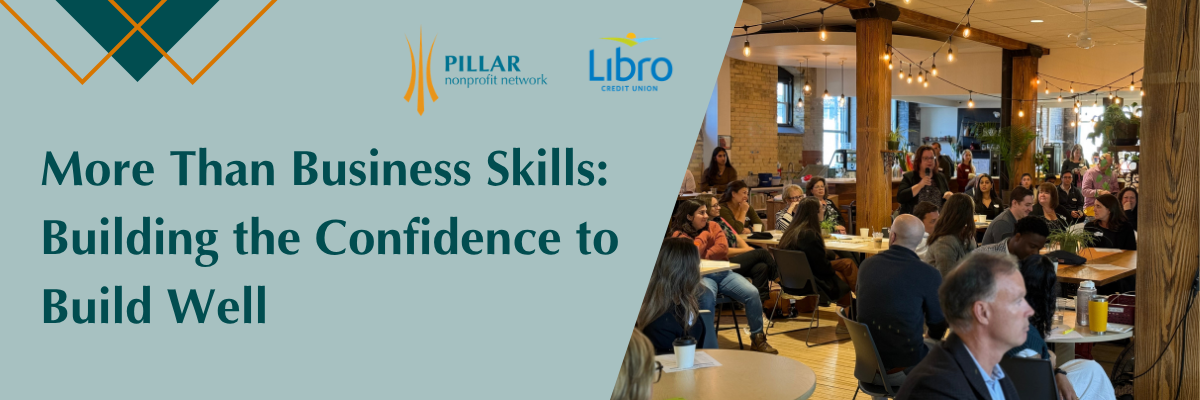
Looking back over the 2026 Libro Social Enterprise Workshop Series, one theme stands out more clearly than any other.
Participants did not simply leave with new knowledge. They left thinking differently.
The workshop series has always been designed to provide practical tools such as business planning, marketing, governance, financial sustainability, and human-centred design, but this year those tools became something more. They became a way for participants to make sense of work they were already doing and to approach it with greater confidence, intention, and clarity.
Several deliberate changes shaped this year's experience. Sessions allowed more time for conversation and reflection, encouraging participants to test ideas with one another rather than simply absorb information. Socialpreneur Chats were scheduled closer to workshop dates, allowing conversations to continue while ideas were still fresh. Instead of ending when a session finished, learning increasingly became something participants carried into their businesses, then brought back to the group for discussion.
The impact became visible in different ways for different people.
For one participant, who entered the program already running community markets, the workshops provided language for something she had struggled with for years: understanding the value of her own work. Through discussions about financial sustainability, pricing, and business planning, she began confronting what she described as a "poverty mindset" around charging for her services. By the end of the program, she had steadily increased vendor fees, launched new workshops, replaced the employment income she had lost earlier in the year, and was generating between $1,200 and $1,800 per event. Just as importantly, she had begun mentoring newer market organizers, multiplying the impact of what she had learned across London's creative community.
Another participant arrived with a very different challenge. She had already developed London's only internationally certified hypnobirthing program and had embedded accessibility into the business through sliding-scale pricing and cultural safety training. Her obstacle wasn't expertise. It was finding her audience.Conversations during the series helped her clarify her value proposition, rethink her marketing strategy, and connect with practical support, including Digital Main Street advertising resources.While her business remains in its early stages, she describes the program as giving her something equally important: a trusted community where difficult questions could be explored without judgement and where each next step felt achievable.
These stories reflect different businesses but remarkably similar patterns.
Participants repeatedly described moving away from seeing business as simply a way to generate income and toward understanding it as a vehicle for creating community impact. Human-Centred Design encouraged them to spend more time listening before developing solutions. Business planning became less about producing a document and more about telling the story of the change they hoped to create. Marketing shifted from promotion toward understanding the people they wanted to serve. Financial discussions became less intimidating as participants realized they didn't need to know everything before beginning.
As one participant reflected, "This workshop helped me see business in a new way. Before I thought only about profit, but now I understand social impact is also very important."
Another shared that the Human-Centred Design session would fundamentally change how they approached their work because it challenged them to slow down and listen before building solutions.
Others described gaining confidence simply by recognizing that uncertainty is part of entrepreneurship. One participant noted that conversations about money felt less intimidating after realizing that no one starts as an expert. Another explained that they now understood a business plan not as paperwork to complete, but as both a story and a practical tool to guide decisions.
Perhaps the most significant outcome of the series is one that is difficult to measure directly.
Participants increasingly began relying on one another. They shared resources, explored collaborations, referred opportunities, challenged each other's thinking, and normalized the uncertainty that comes with building something new. Several collaborations have already emerged, while others continue to develop organically through relationships formed during the workshops and Socialpreneur Chats.
What is becoming increasingly clear is that entrepreneurship development is not simply about transferring knowledge. It is about creating the conditions where people can test ideas, develop confidence, and discover that they are not building alone.
Looking ahead, there is an opportunity to deepen our understanding of these longer-term outcomes. The interviews conducted this year have already revealed stories that would never have appeared in a post-workshop survey, stories about changing mindsets, building relationships, pricing work more fairly, mentoring others, and contributing to stronger local ecosystems.
These stories suggest that the lasting impact of the Libro Social Enterprise Workshop Series extends well beyond the classroom. It is helping build a growing community of social entrepreneurs who are learning together, supporting one another, and strengthening London's social economy one relationship at a time.
These stories are made possible through the Social Enterprise Workshop Series, powered by Libro Credit Union.